The 8 Days Lemosho Kilimanjaro Group Hiking – 7–14 December 2026 departure is a shared, high-acclimatization mountain expedition starting from the western approach at Londorossi Gate (2,100 m) and concluding via Mweka Gate (1,640 m) after ascending Uhuru Peak (5,895 m). Running through an optimal early-December seasonal window, this 8-day itinerary costs between $2,250 and $2,650 per trekker for full mountain operations, covering all Tanzania National Parks (TANAPA) fees, rescue insurance, mountain crews, mess tent dining, portable private loos, pulse oximetry tracking, and emergency medical oxygen. The primary decision for trekkers booking the 7–14 December 2026 dates is securing flights into Kilimanjaro International Airport (JIA/KIA) by 5–6 December to ensure adequate rest and equipment checks in Moshi before western trailheads close for morning registrations.
Expedition Overview: Why 7–14 December 2026 Works
Choosing an expedition window on Mount Kilimanjaro requires balancing mountain traffic, summit weather windows, and physiological adaptation. The 8 Days Lemosho Kilimanjaro Group Hiking – 7–14 December 2026 scheduled departure sits inside an advantageous operational corridor. While the short rains (“Vuli”) technically span late October through November, early to mid-December often witnesses a distinct drying phase before the heavy holiday surges begin around Christmas and New Year. By setting foot on the trail on 7 December 2026, hikers traverse the quiet wilderness of the Shira Plateau without encountering the congested queues common on the Machame or Marangu trails later in the month.
Top Guide Adventures establishes these set-date groups to ensure small, coherent pods—typically limited to 6 to 10 trekkers—which allows mountain guides to supervise physiological parameters without diluting team safety. The western approach across the Lemosho Glades yields an extended wilderness experience during the initial 48 hours. Trekkers walk beneath ancient podocarpus forest canopies where sightings of black-and-white colobus monkeys and blue monkeys remain frequent, well away from the louder southern trail junctions.
For individuals weighing group-joining alternatives during this month, related departures like the 8 Days Lemosho Kilimanjaro Trekking Package – 4–11 December 2026-2027 or the rapid 7 Days Lemosho Route Kilimanjaro Group Trek – 6–12 December 2026-2027 operate nearby, but an eight-day progression remains the gold standard for reaching Uhuru Peak without severe acute mountain sickness (AMS). Adding that critical eighth day drops the physiological strain markedly by splitting the high-altitude traverse between Shira 2, Lava Tower, and Barranco Camp.
Lemosho 8-Day Physical Profile, Elevation Gains & Camp Metrics
The Lemosho Route is structurally superior because it allows hikers to “walk high and sleep low” across consecutive stages. Over eight days, you cover roughly 70 kilometers of mountain terrain, transitioning through five distinct ecological bands: rainforest, heather-moorland, alpine desert, and the arctic summit crater zone. Below is the operational staging matrix utilized for our 7–14 December 2026 climb.
| Day & Date | Start / Finish Camps | Starting Alt (m) | Sleeping Alt (m) | Distance / Time | Vegetation Zone |
|---|---|---|---|---|---|
| Day 1: 7 Dec 2026 | Londorossi Gate to Mti Mkubwa | 2,100 m | 2,820 m | 6 km | 3–4 hrs | Montane Rainforest |
| Day 2: 8 Dec 2026 | Mti Mkubwa to Shira 1 Camp | 2,820 m | 3,610 m | 8 km | 5–6 hrs | Hagenia-Moorland |
| Day 3: 9 Dec 2026 | Shira 1 to Shira 2 Camp | 3,610 m | 3,850 m | 7 km | 3–4 hrs | Sub-Alpine Moorland |
| Day 4: 10 Dec 2026 | Shira 2 to Lava Tower to Barranco | 3,850 m | 3,976 m (Peak: 4,630 m) | 10 km | 6–7 hrs | Alpine Desert |
| Day 5: 11 Dec 2026 | Barranco to Karanga Camp | 3,976 m | 3,995 m | 5 km | 4–5 hrs | Alpine Desert |
| Day 6: 12 Dec 2026 | Karanga to Barafu Base Camp | 3,995 m | 4,673 m | 4 km | 3–4 hrs | Stone Scree / Alpine Desert |
| Day 7: 13 Dec 2026 | Barafu to Uhuru to Mweka Camp | 4,673 m | 3,100 m (Uhuru: 5,895 m) | 17 km | 12–14 hrs | Arctic Summit to Heath |
| Day 8: 14 Dec 2026 | Mweka Camp to Mweka Gate | 3,100 m | 1,640 m | 10 km | 3–4 hrs | Montane Rainforest |
Understanding these vertical intervals helps clarify why eight days yields a summit success rate exceeding 90% for our teams. The transition from Londorossi through Shira 1 introduces the body gradually to thin air, unlike shorter variations such as the 6 Days Machame Route Kilimanjaro Group Trek – 3–8 December 2026-2027 or cabin-based options like the 6 Days Marangu Kilimanjaro Group Hiking – 9–14 December 2026-2027, where rapid ascents test unacclimatized muscle and pulmonary tissue aggressively.
Tactical Trail Breakdown: Days 1 to 4 (Londorossi to Barranco)
Success on an 8-day expedition depends on how disciplined you remain through the initial four stages. Many trekkers assume physical difficulty increases uniformly, but the earliest structural error is pushing the walking pace on low-angle terrain in the rainforest, burning glycogen reserves needed on the high plateau.
Day 1: Londorossi Gate (2,100 m) to Mti Mkubwa Camp (2,820 m)
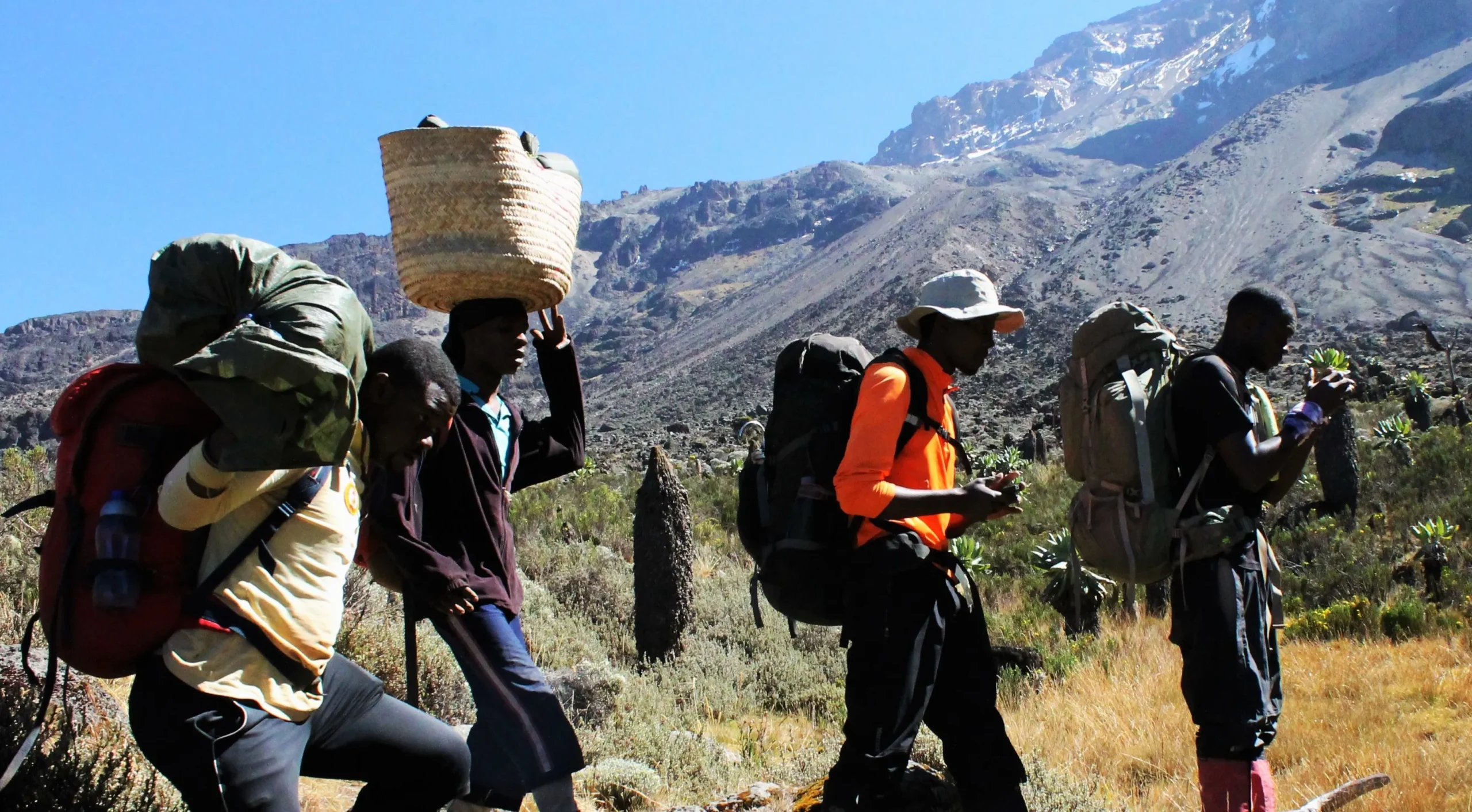
Following morning pickups from your hotel in Moshi or Arusha, our transport maneuvers west toward the agricultural lands of Sanya Juu before climbing through the protected perimeter to Londorossi Gate. Park entry formalities managed by the Tanzania National Parks Authority (TANAPA) require thorough passport verification and porter bag weighing. Each porter carries a maximum of 20 kilograms, with personal gear strictly held to a 15-kilogram limit per client.
The trek initiates on a 4WD forest track before narrowing into an earthen pathway through the pristine western montane forest. The air under the canopy remains humid. Because early December can present late-afternoon precipitation, high-grade waterproof shells and pack liners should remain easily accessible inside your daypack. You reach Mti Mkubwa (“Big Tree”) Camp by late afternoon. Your camp crew sets the tents, boils water for washing, and serves an energizing hot meal in the dedicated mess tent.
Day 2: Mti Mkubwa Camp (2,820 m) to Shira 1 Camp (3,610 m)
The trail exits the dense montane canopy within ninety minutes of departure, emerging into the dramatic heather and moorland zones. Here, giant heathers (Erica arborea) rise along twisting rocky ridges. You gain noticeable vertical ground as you cross the northern boundary of the Shira Ridge, an ancient collapsed volcanic caldera that preceded Kibo.
The gradient steepens over volcanic shelves before flattening out as you crest into the Shira Caldera. Temperatures shift noticeably: radiant solar heat during midday gives way to crisp alpine drafts as cloud cover rises from the valley. Arrival at Shira 1 Camp delivers expansive western views back toward Mount Meru, offering a serene, remote camp atmosphere rarely matched by the busier eastern trail entrances.
Field Hydration Standard: Dehydration mimics and accelerates acute altitude sickness. On the transit from Mti Mkubwa to Shira 1, guide protocols require trekkers to consume a minimum of 3 to 4 liters of treated water daily. Electrolyte replacement tabs should be rotated into bladder systems to counterbalance mineral loss caused by prolonged uphill respiration.
Day 3: Shira 1 Camp (3,610 m) to Shira 2 Camp (3,850 m)
Day three is an intentionally metered, steady traverse eastward across the sprawling floor of the Shira Plateau toward Kibo’s jagged western flanks. The physical elevation gain is modest—roughly 240 vertical meters over seven kilometers—providing a critical active-recovery interval that assists natural acclimatization.
This stage introduces hikers to bizarre, high-altitude flora such as the giant groundsel (Dendrosenecio kilimanjari) and lobelias. You reach Shira 2 Camp early in the afternoon, leaving plenty of daylight for equipment drying, rest, and an optional 45-minute evening acclimatization walk up the surrounding rocky ridges with your lead guide. The expansive vistas here reveal the massive Western Breach and the icy crowns of the Furtwängler Glacier glowing during sunset.
Hikers wanting alternative routes across this terrain during the 2026-2027 season sometimes look at the 7 Days Machame Kilimanjaro Group Climb – 9–15 December 2026-2027 or compare options like the Best 8 Day Kilimanjaro Lemosho Route Trekking Package from Moshi 2026-2027. However, the gentle horizontal pacing between Shira 1 and Shira 2 is exclusively preserved on the 8-day Lemosho layout.
Day 4: Shira 2 Camp (3,850 m) to Lava Tower (4,630 m) to Barranco Camp (3,976 m)
Day four is the physiological centerpiece of the mid-mountain acclimatization schedule. Departing Shira 2, the route heads southeast into the arid alpine desert, ascending an exposed moonscape where vegetation dwindles to lichen-encrusted volcanic scree. The climb feels noticeably taxing as you approach the base of Lava Tower—a 90-meter-high volcanic plug jutting into the thin atmosphere at 4,630 meters.
Trekkers stop at Lava Tower for lunch and rest for nearly an hour. Spending time at this altitude triggers your kidneys to produce erythropoietin (EPO), stimulating red blood cell production. Mild headaches or slight nausea can occasionally surface here; our guides use this stop to evaluate each climber’s adaptation through resting heart rates and blood oxygen saturation (SpO2) readings.
From Lava Tower, you descend through the boulder-strewn Senecio Valley into Barranco Camp, dropping nearly 650 meters below your peak height for the day. This embodies the foundational mountaineering tenet: climb high, sleep low. You fall asleep at 3,976 meters, but your system retains the physiological adaptations sparked by breathing the thin air at 4,630 meters earlier that afternoon.
Acclimatization Architecture: The Western Approach Advantage
Ascending an ultra-prominent freestanding stratovolcano requires respect for barometric shifts. At the summit of Mount Kilimanjaro (Uhuru Peak, 5,895 m), the effective oxygen concentration remains at 20.9%, but the atmospheric pressure drops to less than half of sea-level value (around 480 millibars versus 1,013 millibars). Consequently, every single breath takes in roughly 50% fewer oxygen molecules into your bloodstream.
On fast-tracked five-day ascents, like the 5 Days Marangu Route Kilimanjaro Group Climb – 8–12 December 2026-2027, the human vascular system simply lacks the time required to adjust bicarbonate buffers in cerebrospinal fluid. Trekkers are far more susceptible to severe altitude complications, such as High Altitude Pulmonary Edema (HAPE) or High Altitude Cerebral Edema (HACE), which necessitate immediate evacuation down the mountain.
The 8 Days Lemosho Kilimanjaro Group Hiking – 7–14 December 2026 routing avoids this pitfall entirely through deliberate architectural pacing:
Check Availability for 8 Days Lemosho Kilimanjaro Group Hiking – 7–14 December 2026-2027
Ready to compare dates, prices, and the best option for your group? Send the package name and travel month so the team can reply with a clear quote, availability, and what is included.
8 Days Lemosho Route Kilimanjaro Group Departure – 12–19 December 2026-2027
A detailed guide to the 8-day Lemosho Route Kilimanjaro group climb departing 12–19 December 2026, covering route details, daily itinerary, acclimatization strategy, and what to expect.
View package details
7 Days Lemosho Route Kilimanjaro Group Climb – 3–9 December 2026-2027
7 Days Lemosho Route Kilimanjaro Group Climb – 3–9 December 2026 is explained with current 2026-2027 planning, price, itinerary and booking information.
View package details
8 Days Lemosho Kilimanjaro Full Moon Group Trek – 18–25 December 2026-2027
An 8-day group trek on Kilimanjaro's scenic Lemosho Route timed for the December 2026 full moon period, with summit day on Christmas morning.
View package details8 Days Lemosho Route Kilimanjaro Group Climb – 15–22 December 2026-2027
8 Days Lemosho Route Kilimanjaro Group Climb – 15–22 December 2026 is explained with current 2026-2027 planning, price, itinerary and booking information.
View package details
7 Days Lemosho Route Kilimanjaro Group Trek – 6–12 December 2026-2027
7 Days Lemosho Route Kilimanjaro Group Trek – 6–12 December 2026 is explained with current 2026-2027 planning, price, itinerary and booking information.
View package details
7 Days Machame Kilimanjaro Group Climb – 9–15 December 2026-2027
A detailed guide to the 7-day Machame Route Kilimanjaro group climb in December 2026, covering itinerary, preparation, and what to expect.
View package details
6 Days Marangu Kilimanjaro Group Hiking – 9–14 December 2026-2027
6 Days Marangu Kilimanjaro Group Hiking – 9–14 December 2026 is explained with current 2026-2027 planning, price, itinerary and booking information.
View package details
6 Days Machame Route Kilimanjaro Group Trek – 3–8 December 2026-2027
A detailed guide to the 6-day Machame Route Kilimanjaro group trek departing 3–8 December 2026, covering route details, daily itinerary, preparation, and booking.
View package details5 Days Marangu Route Kilimanjaro Group Climb – 8–12 December 2026-2027
5 Days Marangu Route Kilimanjaro Group Climb – 8–12 December 2026 is explained with current 2026-2027 planning, price, itinerary and booking information.
View package details
8 Days Lemosho Kilimanjaro Group Joining – 29 December – 5 January 2026-2027
8 Days Lemosho Kilimanjaro Group Joining – 29 December 2026 – 5 January 2027 is explained with current 2026-2027 planning, price, itinerary and booking.
View package details7 Days Lemosho Kilimanjaro Group Joining – 12–18 December 2026-2027
7 Days Lemosho Kilimanjaro Group Joining – 12–18 December 2026 is explained with current 2026-2027 planning, price, itinerary and booking information.
View package details8 Days Lemosho Kilimanjaro Christmas Trek – 24–31 December 2026-2027
8 Days Lemosho Kilimanjaro Christmas Trek – 24–31 December 2026 is explained with current 2026-2027 planning, price, itinerary and booking information.
View package detailsNo closely related package is available yet for this topic.

Our Guest Reviews, Currently Feedback from Clients in 2026
Reviews from different sources, including Google Business, Tripadvisor, other platforms, and social media.