
Yes, you can reliably see baby wildebeest in Ndutu during February, as this month marks the synchronized peak of the Great Migration calving season. Between late January and early March—with mid-February representing the absolute apex—roughly 8,000 wildebeest calves are born each day across the short-grass plains straddling the southern Serengeti and Ngorongoro Conservation Area. Planning a 4 to 6-day dedicated migration itinerary starting from Arusha gives travelers the highest statistical likelihood of watching a live birth, following newborn calves as they stand within minutes, and observing intense predator interactions on open ground. For the 2026-2027 safari seasons, securing mobile tented camps near Lake Ndutu 6 to 9 months ahead remains essential due to high demand among wildlife photographers and seasoned safari travelers.
Why February is the Synchronized Calving Peak in Ndutu
The annual arrival of newborn wildebeest across the Ndutu plains is not a gradual, drawn-out event; it is an evolutionary phenomenon known as predator satiation. Over a compressed window of two to three weeks, predominantly falling within February, female white-bearded wildebeest drop approximately 400,000 to 500,000 calves. By flooding the plains with hundreds of thousands of vulnerable newborns at the exact same time, the herd ensures that local apex predators—lions, cheetahs, spotted hyenas, leopards, and caracals—become physically overwhelmed by the sheer volume of prey, allowing the vast majority of calves to survive their first critical weeks.
This timing is directly tied to the nutritional chemistry of the soil and vegetation. In late October and November, short seasonal rains fall across the southern volcanic plateau between the Ngorongoro Highlands and the Serengeti plains. Ash deposits from ancient eruptions of volcanoes like Olmoti and the still-active Oldoinyo Lengai enriched these soils with immense concentrations of phosphorus, potassium, and bio-available calcium. When the grasses sprout in January and February, they provide lactating mothers with the exact mineral balance required for milk production and rapid skeletal development in newborn calves.
For anyone reviewing the best time to book a Tanzania wildebeest migration safari, February stands out because calving activity is concentrated within a relatively compact radius. Unlike the dry-season river crossings along the northern Mara River in July and August—where herds might pause on high ridges for days before committing to water—the southern plains host a massive, continuous carpet of animals. You do not wait hours for a fleeting movement; the nursery herds encircle your vehicle across the open horizons of Lake Ndutu and Lake Masek.
Ndutu Plains Geography: Navigating the NCAA and Southern Serengeti Boundary
A frequent point of confusion for first-time visitors is determining where Ndutu actually sits on a map. Ndutu is not an independent national park. Instead, it is an ecological basin that straddles an invisible administrative border separating two distinct conservation jurisdictions: the Ngorongoro Conservation Area (NCAA) to the south and east, and Serengeti National Park (TANAPA) to the north and west.
This jurisdictional division has profound operational implications for your safari. Understanding the boundary determines how your guide maneuvers, how daily park permits are billed, and how closely you can approach dynamic wildlife events.
Permit and Operational Tip: Accommodations located on the NCAA side of Ndutu require Ngorongoro Conservation Area daily entry fees, whereas crossing northward past the ranger markers requires an active Serengeti National Park permit. An experienced safari operator structures your transit days to avoid paying dual park fees on days when your game drives stay confined to one regulatory zone.
The physical landscape of Ndutu consists of several interconnected habitats that support the herds during February:
- The Short-Grass Plains: Flat, treeless expansions stretching toward Oldupai Gorge, Gol Kopjes, and Salei. The lack of cover makes it difficult for predators to stalk undetected, which is why pregnant wildebeest prefer these open areas to give birth in broad daylight.
- The Acacia Woodlands: Belts of umbrella thorn (Vachellia tortilis) and yellow-barked fever trees bordering the seasonal lakes. These woods offer shade during midday heat and serve as territory for resident leopards, breeding giraffe herds, and elephant families.
- Lake Ndutu and Lake Masek: Shallow, alkaline soda lakes that act as crucial water sources and mineral licks. While Lake Masek holds water year-round, Lake Ndutu fluctuates based on the strength of the seasonal rains, attracting flamingos and thousands of migrating waterbirds alongside the calving ungulates.
- Marshlands and Drainage Basins: The Ndutu marsh provides spongy, water-retaining soils where sweet marsh grasses persist even when the surrounding plains dry out during brief mid-February rainfall gaps.
If you are planning an itinerary that links the southern plains with other northern circuit destinations, travelers often combine Ndutu with a descent into Ngorongoro Crater. You can read our analysis on whether you can see the Big Five animals in Ngorongoro Crater to understand how the crater floor complements the vast, open-plains predator viewing of Ndutu.
What a Typical Calving Day Looks Like: Births, Nursery Herds, and Predators
Experiencing the calving season in February involves an intense, fast-paced rhythm distinct from standard game drives. Calving activity does not follow human schedules, but wildebeest mothers exhibit clear behavioral patterns designed to give their offspring the greatest survival margin.
The majority of births happen between 9:00 AM and 1:00 PM. While this strikes many visitors as counterintuitive—given that midday is typically the quietest period on an African safari—wildebeest deliberately calve when big cats are sluggish and hunting conditions are least favorable for heat-sensitive predators. During these midday hours, pregnant females move slightly away from the dense center of the herd, drop onto the short grass, and deliver within 10 to 30 minutes.
A newborn wildebeest calf possesses one of the fastest developmental timelines of any mammal on Earth:
- 0 to 3 Minutes: The mother cleans the embryonic sac from the calf’s nose and stimulates breathing through vigorous licking.
- 3 to 8 Minutes: The calf attempts to sit upright, shakes its head, and makes its first efforts to stand on long, wobbly legs.
- 8 to 15 Minutes: The calf stands fully, nurses its first colostrum rich in maternal antibodies, and imprints on its mother’s unique scent and call.
- 20 to 45 Minutes: The calf can run alongside its mother at speeds up to 30 miles per hour, capable of evading hyenas and staying locked to the female’s flank amidst moving herds.
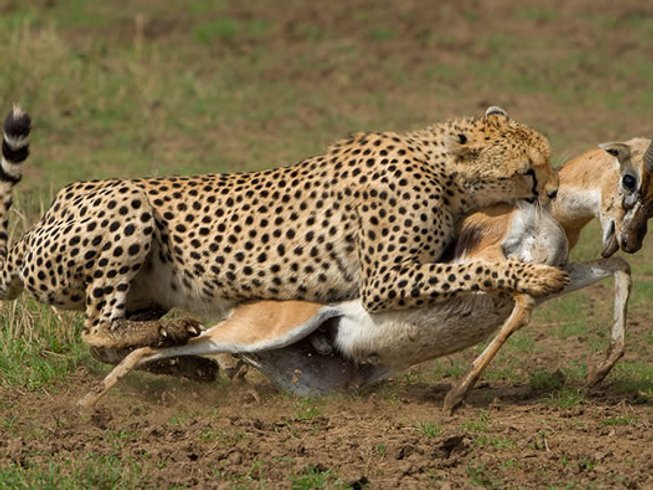
Predator interactions during February are remarkably raw. Spotted hyenas patrol the plains in large packs, relying on endurance and sheer numbers to test the coordination of nursery groups. Cheetahs utilize small termite mounds or tree trunks to survey the open ground, looking for isolated calves that lose visual contact with their mothers in the dust. Lion prides, often anchored around the nearby kopjes, mount coordinated ambushes along drainage lines where herds file down to drink.
Travelers considering our February Ndutu wildebeest calving safari tours with prices will note that we recommend full-day game drives with packed bush breakfasts and lunches. Heading back to a lodge at 11:00 AM causes you to miss the exact operational window when births and midday hunts peak across the plains.
Calving Months Compared: January vs. February vs. March
While the broader calving season extends across the first quarter of the year, subtle climatic and behavioral shifts occur between January, February, and March. Choosing your exact travel dates determines the types of behavior you encounter, the ground conditions you navigate, and the density of safari traffic around Lake Ndutu.
| Safari Factor | January (Early Arrival) | February (Peak Calving) | March (Green Transition) |
|---|---|---|---|
| Calving Intensity | Sporadic births; herds arrive and settle; pregnant females dominate. | Peak synchronized birthing; 8,000+ calves born daily. | Late births; majority of calves are older, faster, and mobile. |
| Predator Density | Predators regroup around the southern plains perimeter. | Maximum predator activity; cheetah hunts and hyena chases daily. | Predators follow thinning herds as they test western corridors. |
| Off-Road Driving | Permitted in NCAA sectors; plains generally firm. | Permitted in NCAA sectors; localized mud after heavy afternoon storms. | Permitted, but black cotton soil requires careful driving around marshes. |
| Plains Scenery | Vibrant green; short, sweet grasses growing rapidly. | Lush green carpet mixed with open dusty pans on dry days. | Taller grasses; early wildflowers appear; herds begin westward drift. |
| Recommended Stay | 3 nights minimum to track arriving columns. | 3 to 5 nights directly in Ndutu or Kusini. | 3 nights combined with Central Serengeti (Seronera). |
| Camp Availability | Moderate to high; easier booking window. | Extremely tight; book 6 to 9 months ahead for 2026-2027. | Moderate; last-minute gaps appear toward late March. |
January serves as an excellent option for travelers who prefer quieter plains and want to witness the arrival of massive migratory columns from the central valleys. However, if your absolute priority is witnessing live births and small calves taking their first steps, February remains the gold standard.
By March, the dynamic changes. While there are still calves present, most are several weeks old, remarkably agile, and less vulnerable to lone predators. Heavy rains begin to saturate the volcanic soils, creating sticky black cotton mud that tests even modified 4×4 vehicles. Herds also begin to break into splinter groups, preparing to drift northwest toward the Maswa Game Reserve and Moru Kopjes.
If you are exploring shared group options, review our verified Tanzania safari group joining departures in February to see how daily seat schedules align with peak birthing dates.
Off-Road Driving Rules and Wildlife Viewing Realities in Ndutu
One of the primary reasons wildlife photographers, documentary crews, and experienced private travelers prioritize Ndutu over other Serengeti sectors is the regulatory policy regarding off-road driving.
In standard national parks across Tanzania—including the Central Serengeti (Seronera), Northern Serengeti (Kogatende), and Tarangire—off-road driving is strictly prohibited by TANAPA regulations. Safari vehicles must remain entirely on established gravel and dirt tracks. If a kill takes place 300 meters out in the grass, visitors must view it through binoculars or long telephoto lenses from the road shoulder.
In the Ngorongoro Conservation Area section of Ndutu, off-road driving is legally permitted, provided guides follow established conservation guidelines. This fundamental difference transforms the quality of your game viewing during February:
- Close Proximity to Births: Your guide can carefully position the 4×4 Land Cruiser within respectful viewing distance of a laboring female without violating conservation laws.
- Tracking Fast Hunts: When a cheetah begins stalking an impala or newborn wildebeest on the open savanna, vehicles can maneuver across the open grassland to follow the hunt from an ethical distance.
- Unobstructed Photography Angles: Photographers can work with eye-level perspectives, repositioning for front-lighting or back-lighting without being constrained by fixed track networks.
However, off-road driving carries serious environmental responsibilities. Responsible operators like TOP GUIDE ADVENTURES enforce clear field standards: guides do not encircle hunting cats, cut off escape routes for targeted prey, or drive across sensitive marsh beds where deep wheel ruts can scar the landscape for years. Maintaining respectful distance ensures mothers do not abandon newborn calves due to vehicle stress.
Understanding vehicle dynamics is equally vital. In February, rain showers can transform dry lake flats into deceptive clay pans within minutes. A high-clearance, four-wheel-drive extended Land Cruiser equipped with differential locks, heavy-duty recovery winches, mud chains, and high-lift jacks is not a luxury in Ndutu—it is an absolute mechanical necessity.
Camp Selection and Safari Cost Logic for February 2026-2027
Planning a safari to see baby wildebeest in Ndutu requires a clear grasp of lodging types, seasonal pricing tiers, and transit logistics. Because Ndutu is a seasonal migration hotspot, the accommodation infrastructure is split between two primary categories:
1. Semi-Permanent Mobile Tented Migration Camps
These luxury and mid-range canvas camps follow the Great Migration across the calendar. From December to late March, they pitch their spacious walk-in tents in designated wilderness zones surrounding Lake Ndutu and Kusini. By April, they pack down and relocate to the Western Corridor or Northern Serengeti.
Check Availability for Can I See Baby Wildebeest In Ndutu During February? 2026-2027
Ready to compare dates, prices, and the best option for your group? Send the package name and travel month so the team can reply with a clear quote, availability, and what is included.

February Ndutu Wildebeest Calving Safari Tours With Prices 2026-2027
February 2027 Ndutu Wildebeest Calving Safari Tours with Prices is explained with current 2026-2027 planning, price, itinerary and booking information.
View package details
When Does The Wildebeest Calving Season Start In Ndutu? 2026-2027
When Does the Wildebeest Calving Season Start in Ndutu? is explained with current 2026-2027 planning, price, itinerary and booking information.
View package details
Is January Or February Better For A Ndutu Migration Safari? 2026-2027
Is January or February Better for a Ndutu Migration Safari? is explained with current 2026-2027 planning, price, itinerary and booking information.
View package detailsNo closely related package is available yet for this topic.

Our Guest Reviews, Currently Feedback from Clients in 2026
Reviews from different sources, including Google Business, Tripadvisor, other platforms, and social media.



