
Tanzania safari group joining departures in January 2027 are scheduled, shared-vehicle Northern Circuit itineraries where solo travelers, couples, and small travel pods book individual seats in an 8-seat 4WD custom Land Cruiser to divide the fixed operational costs of vehicle hire, professional guide fees, fuel, and park transit permits. Running daily and on set departure windows from Arusha and Moshi, these shared trips typically span 3 to 7 days across Tarangire, Lake Manyara, the Ngorongoro Crater, and the Serengeti. In January, routes are strategically adjusted south toward the Ndutu and Southern Serengeti plains to track the Great Migration calving season, with typical shared rates ranging from $200 to $360 per person per day for basic camping and $390 to $680 per person per day for mid-range lodge accommodation.
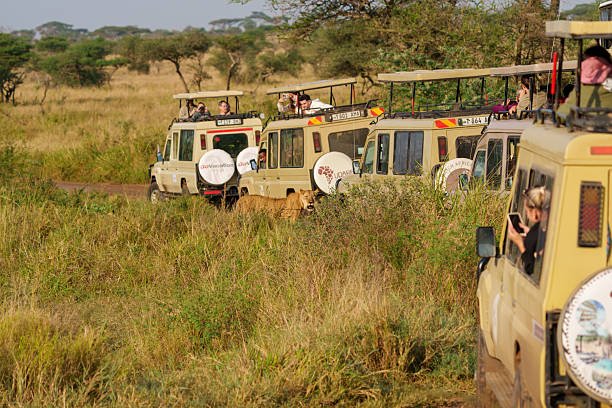
How January 2027 Group Joining Safaris Operate in Northern Tanzania
A group joining departure brings together unaffiliated travelers into a single organized safari party to make Northern Tanzania accessible without bearing the $350 to $600 daily cost of a private vehicle, fuel, and driver-guide. While private safaris offer absolute schedule flexibility, Tanzania group joining safari daily departures run on coordinated operational schedules established by local ground handlers in Arusha and Moshi.
In January, departures encounter one of the two annual high-demand travel peaks in East Africa. The timing coincides with the northern hemisphere winter holidays and the commencement of the synchronized wildebeest calving on the short-grass plains between the Ngorongoro Conservation Area and Southern Serengeti. Because of this wildlife event, vehicle seats fill quickly. Top Guide Adventures coordinates group pickups across hotels in Arusha urban areas starting between 07:30 and 08:30 on day one, heading straight out along the Makuyuni corridor to maximize game-drive hours.
Understanding the operational framework of a shared safari helps prevent common traveler misunderstandings:
- Fixed Daily Agendas: The route, overnight camps or lodges, meal stop points, and departure times are set in advance. Game drives typically commence at 06:00 or 06:30 for early light and predator activity, wrapping up before the gates close at 18:00 pursuant to Tanzania National Parks Authority (TANAPA) regulations.
- Regulated Passenger Headcounts: Quality operators cap shared vehicles at six to seven guests in an extended nine-seat safari vehicle. This guarantees every passenger an exterior window seat and unhindered access to the central pop-up roof hatch during wildlife tracking.
- Centralized Staging Hubs: Nearly all Northern Circuit shared safaris begin and end in Arusha or Moshi. Pre-safari and post-safari accommodations in these gateway towns are usually arranged as optional add-ons, though Tanzania group joining safari tours with airport pickup simplify transfers from Kilimanjaro International Airport (JRO) directly to your briefing hotel.
January 2027 Departure Timing Advisory: Early January (January 1 to January 7) carries premium festive carry-over demand. If your travel dates fall in mid-to-late January, you will experience lower crowds along the main Karatu transit roads while still arriving in time for the calving season peak in the southern Serengeti ecosystem.
Shared Safari Pricing and Cost Realities for 2026-2027
Pricing for a group joining safari is driven primarily by fixed park entry concessions, conservation service levies, vehicle operations, and your choice of accommodation. In 2026 and 2027, statutory park fees make up over 40% of the daily package price on Northern Circuit itineraries. For example, Serengeti National Park entry is priced at $82.60 per adult per 24-hour period (inclusive of VAT), while descending into the Ngorongoro Crater incurs a separate $295 vehicle descent permit fee alongside the per-person conservation fee of $70.80.
When you book a private vehicle for one or two travelers, that $295 crater fee falls entirely on your party. In a shared group of six, the crater vehicle fee splits to roughly $49 per traveler, creating massive cost savings. Reviewing the private vs group joining Tanzania safari cost comparison reveals that solo travelers and couples save between 35% and 55% by booking seats on a group departure.
| Departure Style | Target January 2027 Daily Rate (pp) | Accommodations Used | Crater & Serengeti Fees | Best Suited For |
|---|---|---|---|---|
| Shared Basic Camping | $210 – $340 / day | Public TANAPA campsites (tents, mattresses, field cook) | Included in group base | Solo travelers, students, backpackers, adventurous couples |
| Shared Mid-Range Lodge | $390 – $640 / day | Permanent tented camps, masonry safari lodges (en-suite) | Included in group base | Value seekers, couples, mature solo travelers wanting comfort |
| Semi-Luxury Shared Joining | $680 – $980 / day | Boutique seasonal wilderness camps (Ndutu corridor) | Included in group base | Wildlife photographers, bucket-list travelers on a budget |
Beyond the base daily price, you must budget for discretionary tips and accommodation room allocations. In shared lodge departures, rooms are paired on a twin-sharing basis (two single beds) or double basis (one large bed). If you are a solo traveler and do not want to be paired with an unfamiliar guest of the same gender, you will need to pay a single room supplement. Learning how much you can save by joining a group safari in Tanzania involves factoring in this single supplement, which usually adds $50 to $120 per night at mid-range properties.
Estimated 5-Day Northern Circuit Group Joining Budget (January 2027)
- Camping Departure Base: $1,150 – $1,450 per person (covers transport, park fees, 3 meals/day, camp gear, safari guide, field cook).
- Mid-Range Lodge Departure Base: $1,950 – $2,750 per person (twin/double sharing, full board, park permits, transfers).
- Single Supplement (Lodge only): $220 – $480 total for the itinerary.
- Crew Tipping (Standard Field Etiquette): $15 – $20 per day per guest for the driver-guide; $10 – $15 per day total per guest for the camp cook (on camping departures).
- International / Domestic Flights: Not included; requires personal booking into JRO or Arusha Airport (ARK).
Wildlife Dynamics: Why January Shakes Up Standard Group Routes
The core geographic distinction of a January safari departure compared to a mid-year dry-season departure is the position of the Great Migration. From July through October, migration herds congregate in the Northern Serengeti near the Mara River. By January, the herds have migrated southward through the Central Seronera valley onto the nutrient-packed volcanic soils of the Southern Serengeti and western Ngorongoro Conservation Area, specifically the Ndutu basin.
January brings the brief inter-monsoon dry period between the short rains of November/December and the long rains of late March through May. The plains are lush, carpets of green grasses are emerging, and hundreds of thousands of wildebeest, zebras, and Thomson’s gazelles gather across open terrain. By mid-to-late January, the synchronized calving begins: roughly 8,000 wildebeest calves are born daily over a concentrated three-week window.
Check Availability for Tanzania Safari Group Joining Departures In January 2026-2027
Ready to compare dates, prices, and the best option for your group? Send the package name and travel month so the team can reply with a clear quote, availability, and what is included.

Tanzania Safari Group Joining Tours For Couples And Friends 2026-2027
Tanzania Safari Group Joining Tours for Couples and Friends is explained with current 2026-2027 planning, price, itinerary and booking information.
View package details
How Much Can I Save By Joining A Group Safari In Tanzania? 2026-2027
How Much Can I Save by Joining a Group Safari in Tanzania? is explained with current 2026-2027 planning, price, itinerary and booking information.
View package details
Tanzania Group Joining Safari Tours With Airport Pickup 2026-2027
Tanzania Group Joining Safari Tours with Airport Pickup is explained with current 2026-2027 planning, price, itinerary and booking information.
View package details
Tanzania Safari Group Departures With Shared Camping Accommodation 2026-2027
A comprehensive operational guide to Tanzania safari group departures featuring shared public campsite accommodation across the Northern Circuit for 2026-2027.
View package details
Where Can I Find Tanzania Safari Group Joining Tours With Fixed Dates?
Where Can I Find Tanzania Safari Group Joining Tours with Fixed Dates? is explained with current 2026-2027 planning, price, itinerary and booking information.
View package details
Private Vs Group Joining Tanzania Safari Cost Comparison 2026-2027
Private vs Group Joining Tanzania Safari Cost Comparison is explained with current 2026-2027 planning, price, itinerary and booking information.
View package details
How Many People Share A Vehicle On A Tanzania Group Safari? Guide 2026-2027
A comprehensive operational breakdown of vehicle capacity, passenger seating arrangements, window seat guarantees, and luggage space on Tanzania group joining safaris for 2026 and 2027.
View package details
Can I Join A Safari Group From Moshi Instead Of Arusha? 2026-2027
Can I Join a Safari Group from Moshi Instead of Arusha? is explained with current 2026-2027 planning, price, itinerary and booking information.
View package details
Tanzania Safari Packages For Solo Travelers Without Expensive Single
A comprehensive practical guide to booking Tanzania safari packages for solo travelers without paying punitive single supplements, covering group departures, room-share models, private...
View package details
Can I Join A Safari Group Without Sharing A Hotel Room? 2026-2027
Can I Join a Safari Group Without Sharing a Hotel Room? is explained with current 2026-2027 planning, price, itinerary and booking information.
View package details
Affordable Tanzania Wildlife Safari Holidays For Small Groups 2026-2027
Affordable Tanzania Wildlife Safari Holidays for Small Groups is explained with current 2026-2027 planning, price, itinerary and booking information.
View package details
Book Tanzania Safari Tours Directly With Local Tour Companies 2026-2027
Book Tanzania Safari Tours Directly with Local Tour Companies is explained with current 2026-2027 planning, price, itinerary and booking information.
View package detailsNo closely related package is available yet for this topic.

Our Guest Reviews, Currently Feedback from Clients in 2026
Reviews from different sources, including Google Business, Tripadvisor, other platforms, and social media.



